

Saudi Arabia sends more remittances to Pakistan than any other country, and a growing share of that money is going into real estate rather than just household expenses. If you’re working in Riyadh, Jeddah, or anywhere else in the Kingdom and you’re thinking about a plot in Faisal Town Phase 2, you don’t need to fly back to Pakistan to make it happen.
Most of the process picking a plot, sending documents, making payment can be done from where you are, with a Power of Attorney covering anything that legally needs someone present in Pakistan. This guide walks through the documents you’ll need, how payment actually works from Saudi Arabia, the current NOC status, and how to avoid the kind of fraud that’s targeted overseas Pakistani buyers before.
Can Pakistanis in Saudi Arabia Buy Property in Faisal Town Phase 2?
Yes. Pakistanis working or living in Saudi Arabia can buy a plot in Faisal Town Phase 2 using their NICOP or Pakistani passport as identification. You don’t need to be in Pakistan for any part of the process inquiry, document submission, and payment can all be handled remotely, with a Power of Attorney covering anything that legally requires someone physically present there. Overseas Pakistanis, including those based in Saudi Arabia, also qualify for a larger discount than local buyers when paying the full plot price upfront.
The Overseas Enclave was built specifically with non-resident buyers in mind, though general blocks and Model Block sectors are open to Saudi-based buyers too, depending on budget. The sections below cover exactly what’s involved, from documents to payment to the actual booking steps.
Why the Time Difference Between Saudi Arabia and Pakistan Works in Your Favor
Saudi Arabia sits only 2 to 3 hours behind Pakistan, which makes coordinating a remote purchase noticeably easier than it would be from somewhere like the US or Canada. A normal working day in Islamabad overlaps almost entirely with your afternoon and evening in Riyadh or Jeddah, so getting someone on a call or WhatsApp during Pakistani business hours doesn’t mean staying up late or waiting until the next day for a reply. For a process that usually involves a few rounds of questions before you settle on a plot, that small time gap means things move faster than they would for buyers coordinating from much further away.
Documents You’ll Need as a Saudi-Based Buyer
Buying a plot from Saudi Arabia requires a small set of documents to confirm your identity, where you’re currently based, and if you won’t be travelling to Pakistan your authorisation for someone to act on your behalf there. This isn’t specific to Faisal Town Phase 2; it’s the standard paperwork expected from overseas Pakistanis purchasing property anywhere in the country. Many Pakistanis in Saudi Arabia are working under sponsorship-based residency, so proof of your current status there matters as much as proof of your Pakistani identity.
Getting these documents ready before you start the booking process saves time later, since most delays in remote purchases come down to missing paperwork rather than anything to do with the plot itself. The three sections below cover exactly what you’ll need: proof of your Pakistani identity, proof of your residency in Saudi Arabia, and how a Power of Attorney works if you can’t travel.
NICOP or Pakistani Passport
A NICOP (National Identity Card for Overseas Pakistanis) or a valid Pakistani passport is generally required to confirm your identity and Pakistani origin when buying from abroad. This is also typically the document used to claim the overseas lump sum discount, so it’s worth having ready even if you’re planning to pay through installments instead.
Proof of Address / Iqama in Saudi Arabia
Most Pakistanis living in Saudi Arabia hold an Iqama, the residency permit tied to their employment sponsorship, which can serve as proof of where you’re currently based. A recent utility bill or bank statement showing a Saudi address works as an alternative if needed. This confirms your overseas buyer status for documentation purposes, the same way proof of address works for any overseas Pakistani buyer regardless of country.
Power of Attorney Attestation Through the Pakistani Embassy or Consulate in Saudi Arabia
If you can’t travel to Pakistan for signing or transfer, a Power of Attorney lets someone you trust act on your behalf there instead. For Saudi-based buyers, this document typically needs attestation through the Pakistani Embassy in Riyadh or one of the consulates in Jeddah or other major cities before it’s legally usable in Pakistan. This step can take longer than expected, especially around busy periods, so it’s worth starting well ahead of when you actually need it.
How Payment Works From Saudi Arabia
Sending payment from Saudi Arabia works through the same kind of international banking channels used for any large overseas transfer, but there’s one option specific to overseas Pakistanis that’s worth knowing about before you default to a regular bank transfer. Saudi Arabia sends more remittances to Pakistan than any other country, and a meaningful share of that money now goes toward real estate rather than just family support, which is part of why the government has built dedicated channels for exactly this kind of transfer.
Beyond how the money moves, overseas buyers also get a real financial advantage worth factoring in: a larger discount than local buyers receive when paying the full amount upfront. The three sections below cover the recommended transfer method, the alternatives, and how that overseas discount works.
Sending Money via Roshan Digital Account
The Roshan Digital Account is the State Bank of Pakistan’s official platform built specifically for overseas Pakistanis sending money home, and it connects with major Saudi banks. It’s a legitimate, government-backed channel rather than an informal transfer service, which matters for a payment this size both for legal compliance and for having a clear paper trail tied to your purchase. Setting one up takes some initial paperwork, but it’s generally considered the most reliable option for property payments specifically, ahead of standard wire transfers or exchange companies.
Bank Transfer and Exchange Company Options
A standard international wire transfer from a Saudi bank account is also a valid way to send payment, and exchange companies operating in Saudi Arabia can handle same-day transfers for smaller amounts. Confirm the receiving account details directly with the sales team before sending anything, and avoid informal channels like hawala for a property purchase the lack of a formal paper trail can cause real problems if a dispute comes up later.
Overseas Buyer Discount on Lump Sum Payment
Overseas Pakistani buyers, including those based in Saudi Arabia, typically qualify for a larger discount than local buyers when paying the full plot price upfront instead of using installments. For exact discount percentages and pricing by plot size, see our full Payment Plan page.
Booking Around Your Work Contract and Travel Schedule
Most Pakistanis working in Saudi Arabia are on sponsorship-based employment, which means time off and travel back to Pakistan often follow a fixed schedule rather than happening whenever it’s convenient. If your plan involves visiting Pakistan in person at any stage for the final transfer, for a site visit, or just to meet the sales team directly it’s worth mapping that against your actual leave dates rather than assuming you can travel on short notice. Many buyers also use a Hajj or Umrah trip as the occasion to handle property matters in person, since it’s already a planned trip back.
If your residency status or contract is up for renewal soon, it’s worth finishing any document-heavy steps, like signing or attestation, before that renewal period rather than during it, simply because your own paperwork tends to take priority during that window. None of this affects whether you can buy a plot it’s entirely possible to do the whole process remotely but knowing your own schedule in advance makes the process smoother if you do want to be involved in person at some point.
Step-by-Step Booking Process for Saudi-Based Buyers
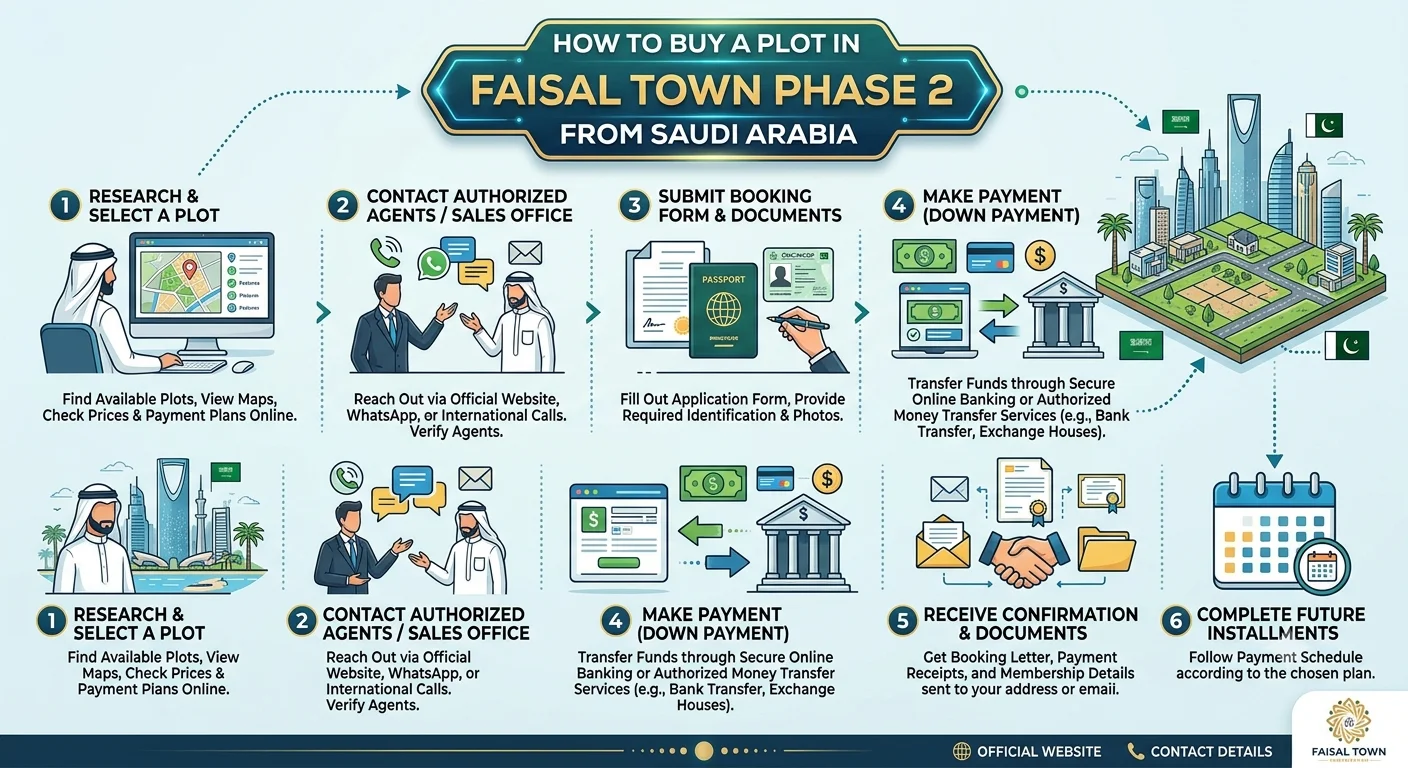
Booking a plot from Saudi Arabia follows the same basic sequence as booking in person, just shifted onto phone, email, and WhatsApp instead of an office visit. You start by getting in touch and picking a plot, move on to sending your documents without needing to be physically present, and finish by confirming the booking once everything’s processed. None of these steps require a trip to Pakistan, as long as your paperwork including a Power of Attorney if you’re using one is sorted in advance. The three sections below walk through each stage in order.
Initial Inquiry and Plot Selection
Start by reaching out through WhatsApp or a contact form to ask about current availability and pricing. From there, you can compare plot sizes and locations against your budget before settling on one, the same way you would if you were asking in person rather than from Saudi Arabia.
Submitting Documents Remotely
Once you’ve picked a plot, you’ll send across your NICOP or passport copy, proof of residency in Saudi Arabia, and Power of Attorney if you’re using one usually by email or WhatsApp. The sales team can confirm exactly which documents they need scanned or photographed before you send them through.
Confirming Booking and Receiving Documentation
Once your documents and initial payment have gone through, you’ll get booking confirmation along with the paperwork tied to your plot. Ask the sales team directly what you should expect to receive and roughly how long it usually takes, since this can vary depending on booking volume and which payment method you used.
Which Block or Sector Should Saudi-Based Buyers Consider?
There’s no single right answer here it depends on your budget and whether you want a community built specifically for overseas buyers. The Overseas Enclave is designed around non-resident Pakistanis, with its own discount structure on lump sum payments. If you’re working with a tighter budget, the general blocks offer lower entry pricing on installment plans, while Model Block sectors sit at a higher price point with closer proximity to the CBD. Saudi-based buyers comparing options sometimes lean toward the Overseas Enclave specifically because its infrastructure and security standards were built with exactly this audience in mind, but that’s a personal preference, not a rule. Whichever direction you’re leaning, it’s worth comparing a couple of options directly with the sales team rather than deciding from a distance based on general descriptions alone.
NOC and Legal Status What Saudi-Based Buyers Should Verify Independently
As of 2026, Faisal Town Phase 2 has not received NOC approval from the Rawalpindi Development Authority. This applies regardless of where you’re buying from, including Saudi Arabia, and it’s stated consistently across multiple sources covering the project, not something unique to one platform.
Development is continuing on the ground despite this, but that doesn’t remove the legal uncertainty that comes with buying before approval is in place. The safest step is checking current NOC status directly through RDA’s own channels rather than taking any sales platform’s word for it, including ours. This matters more, not less, for buyers based in the Gulf specifically, since overseas Pakistanis in this region have historically been targeted by fraudulent housing schemes a point worth taking seriously rather than skipping past. For the full picture on what NOC status means for buyers, see our NOC and RDA Status page.
Avoiding Fraud When Investing From Abroad
Overseas Pakistanis, particularly those based in the Gulf, have been documented targets of real estate fraud fake housing societies, land-grabbing schemes, and agents misrepresenting their authority to sell. This isn’t specific to Faisal Town Phase 2; it’s a pattern that’s affected buyers across many Pakistani housing projects, and it’s worth taking seriously regardless of which society you’re considering.
A few habits genuinely reduce your risk: confirm you’re dealing with the official sales team or a clearly authorized agent, never send payment to an account you haven’t verified directly, and get a written receipt and documentation for every transaction rather than relying on verbal assurances. Be especially cautious of anyone in Saudi Arabia claiming to be the sole authorized representative for a project, or pressuring you to pay quickly before you’ve had time to check the basics. If something about a deal feels rushed or hard to verify, that hesitation is worth listening to taking an extra day to confirm details costs you nothing, while sending money to the wrong place can cost you everything you’ve saved.